

There’s only one more month for you to see Macbeth this Season! Don’t miss out on the production that’s leaving audiences “completely enthralled.”
Like Macduff, Banquo serves as a moral foil to Macbeth. However, where his best friend strays into the darkness in his pursuit of power, Banquo resists, remaining constant for the sake of his son, Fleance—even if he is continuously reminded of the three mysterious figures and what they have prophesized for his son.
Earlier this summer, we had the chance to sit down with Sebastian Kroon (also known as Seabass), who is slipping seamlessly between comedy and tragedy on our BMO Mainstage this Season. Read on to learn about his somewhat serendipitous start in theatre, Bardolph’s many side quests in The Merry Wives of Windsor, and that Ned Stark moment for Banquo in Macbeth.
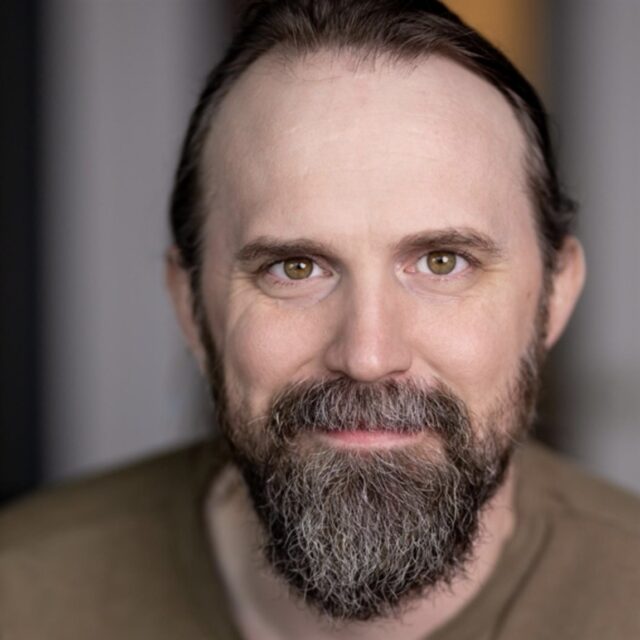 Can you tell us about yourself and how you got into theatre?
How I got into theatre? I went into the wrong room. When I was in Grade 11, my sister wanted to audition for Grease at the Drumheller Composite High School. My mom was sick, so on that cold November night, my sister and I got in the truck and drove down. She went into the waiting room, and I said, “Okay, well, you’re going in there. I’ll wait in here,” and I just walked into the audition room. The drama teacher looked at me and asked, “Are you auditioning?” I said no, but because I was in my football jacket, he said, “Come on, Titans, we need guys.” I said, “Okay, what do you need me to do?” He goes, “Can you sing?” and I said, “I don’t know.” So he told me to sing “Happy Birthday,” and then the musical director taught me “Greased Lightning” there on the spot. I sang it, and then I read a couple of scenes and got cast as Kenickie. My sister didn’t get a part. *laughs*
So I did Grease that summer, which is where I met my buddy Brad, who I played with in a punk band for a couple of years, and my friend Sadie, who was going off to Red Deer College. After the show, I went back to my hometown of Standard and decided that I was going to go to SAIT and become a welder. Then one day I was with Brad at a Drumheller Dinos hockey game, and we ran into Sadie. She grabbed my arm, said “You gotta go to Red Deer. It’ll change your life,” and walked away. So I auditioned for Red Deer College. I got in. Then I auditioned for Studio 58. I got in, and I’ve been here ever since. I try and feel where the universe is pointing me and follow the path of least resistance.
And can you tell us a bit about your journey with Bard?
My first Season with Bard was in 2005, and I worked on the site crew for two years. That was [Site Project Manager] Sean Preston’s first year as well. When I came back from Toronto after doing my solo show, I was looking for work later in the summer, so I was the Facilities Manager here. I cut the grass and changed the recycling and took out the garbage. Then in 2011, I did my first Season as an actor. It was the first year with the new Mainstage tent, and there were no mics, so it was a steep learning curve.
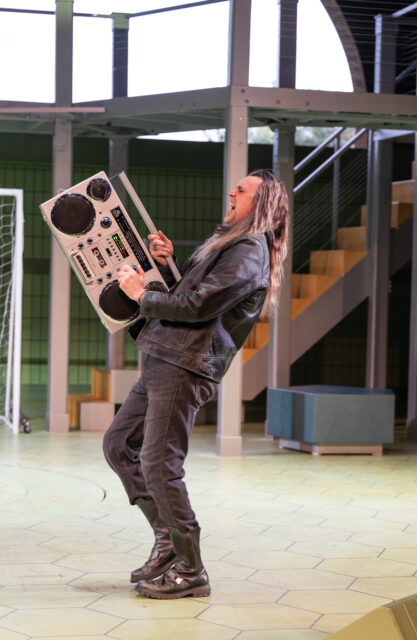
Sebastian Kroon as Bardolph in The Merry Wives of Windsor (2026) | Photo by Emily Cooper
In The Merry Wives of Windsor, you play Bardolph, who’s a bit of a Renaissance man: he works at Thirsty’s Pub, he’s a life drawing model, and he also moonlights as a yoga instructor. What was it like working with director Rebecca Northan to create a character like this?
Rebecca’s such a Renaissance woman herself. She talked a lot about the musicality of the show, and she was always listening to the rhythm of the scene or the joke. It was a privilege to work with her, because I know how to work in that way. As for Bardolph, Rebecca and Bruce Horak knew that they had one actor playing Pistol and Rugby, one actor playing Simple and Anne Page, and one actor that was only playing Bardolph. That freed me up to be in the background and to be, as Rebecca called it, “interesting wallpaper.” Also, the more we worked on the show, the more I discovered about Bardolph. At one point, I have to come on and sing a song. I had tried pop songs and “sad girl” songs, but one night I came in and sang “Ave Maria” as a gag. Rebecca goes, “I think that’s it. I think he really likes classical music.” Those are the internal discoveries that make it rich for me, and that are also the intangible things that the audience can maybe pick up on.
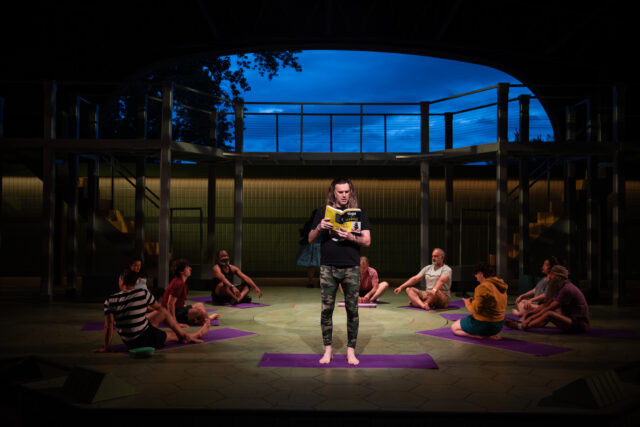
The Company of The Merry Wives of Windsor (2026) | Photo by Emily Cooper
You also understudy Mr. Ford in The Merry Wives of Windsor. What has that been like?
It’s a bit daunting, but Craig Erickson has been so kind and generous. He came to me and told me everything I needed to know, like where to do my changes and what I needed to carry from here to there. In Macbeth, I’m understudied by Zahf Paroo, who’s such an amazing actor. When I went to help him with the understudy runs, he was ready for everything and had good questions to ask. Kenneth Branagh said years ago, when he was starring in and directing the film version of Hamlet, that the person who stood in for him in scenes when he was directing could have played the part of Hamlet. You always want to have someone holding you up that’s at least as good or better than you, and that makes me bring my A-game as an understudy. On the first day of rehearsals, Christopher Gaze quoted someone and said, “Be better than you ever thought you could be.” I feel that here especially. Everyone in this company holds themselves up to such a high degree of excellence. People like Jennifer Lines and Craig Erickson—Bard royalty—are so giving and lead by example. Jen Lines works like a first-year theatre student with something to prove. We all get to see how hard she works, and that permeates into the culture.
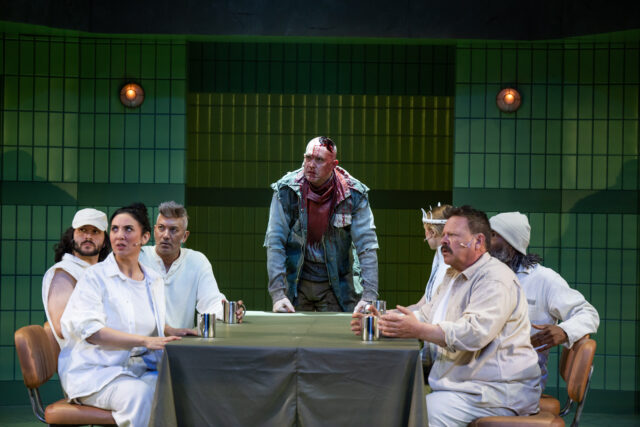
The Company of Macbeth (2026) | Photo by Emily Cooper
Of course, we have to talk about Macbeth as well. What was it like to step into a role like Banquo?
It’s been great. Macbeth’s one of my favourite Shakespeare plays. Banquo’s a character who’s very present, but who doesn’t have a lot to say. He’s set up as the counterpoint to Macbeth. I always put myself in the eyes of someone who’s never seen the show, who’s thinking that Banquo’s going to be the one to stop Macbeth. Then down he goes—I call it the Ned Stark moment—and now, what happens when the guy who was supposed to stop Macbeth is dead? The more I worked on Banquo too, the more I realized that so much of his character—and the play itself—is about fatherhood. I think one of the most poignant moments is when Malcolm says, “Let’s make us med’cines of our great revenge / to cure this deadly grief,” and Macduff responds, “He has no children.” In other words, “I can’t do to him what he’s done to me.” To take that back to Banquo, Macbeth, who has no children, makes the decision to do this terrible thing for greatness. Banquo doesn’t. There’s a scene where Banquo goes, “Why, by the verities on thee made good, / May they not be my oracles as well, / And set me up in hope? But hush! No more.” To me, that decision says, “No, I’m not going to play in darkness. I need to teach my son to be a better man than me, and to stand tall and do the right thing.” The tragedy comes from that not being enough to save me.
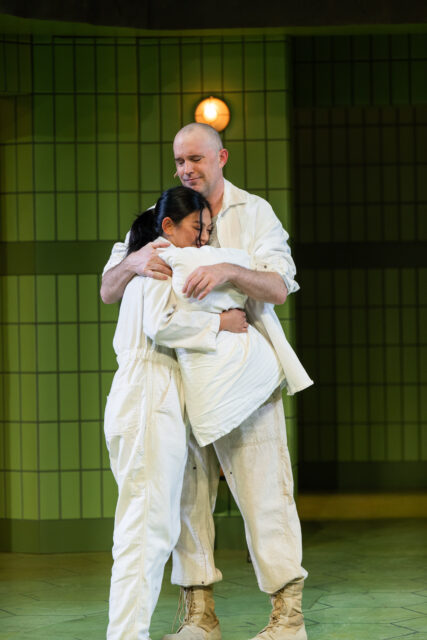
Rachel Angco as Fleance and Sebastian Kroon as Banquo in Macbeth (2026) | Photo by Emily Cooper
The relationship between Banquo and Fleance is so beautiful to watch. How did you work with Rachel Angco to discover that dynamic?
The challenge is that we have to fold so much into so little. We have a scene where we don’t speak, a scene where I check on him before Macbeth’s supposed to murder the king, and then a scene where I only say, “It will rain tonight,” and “Run, Fleance, run!” But we still found some great moments. I find a switchblade in the first scene as part of my scavenging, and so we found an opportunity on stage for me to give that to Fleance. In the same scene, when the king says, “Let’s go,” Fleance is about to leave before the king, and I just stop him like, “The king goes first, and now you can go.” It’s a little micro-moment, but it fills that world. Rachel’s such a fantastic actor, too. She’s so present and open as a performer that it makes finding those interactions very easy.
And what was it like working with Munish Sharma?
It’s been so great to have Munish leading the charge. He is the most generous, wonderful, lovely human being. At the end of the show, he runs off the stage after the bow, and he’s there high-fiving everyone, covered in blood and sweat. Munish and I met 20 years ago doing an audition at the Firehall, and we both remember that day. Neither of us booked the part, but now we’re here, doing this show and playing best friends at Bard on the Beach.
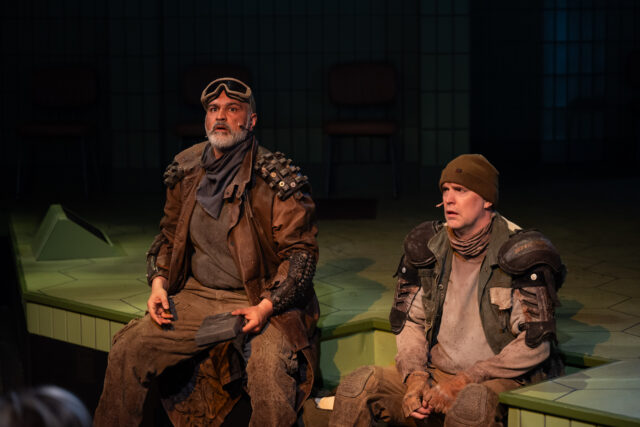
Munish Sharma as Macbeth and Sebastian Kroon as Banquo in Macbeth (2026) | Photo by Emily Cooper
In addition to your work as a performer, you’re also a writer and a puppeteer. Can you tell us a bit about that side of your practice?
I graduated from theatre school in 2007, and I’ve had success, but I’ve also had to do a lot of other things. I wrote a solo show, went off to Toronto to perform it, and brought it back here. I worked with the Old Trout Puppet Workshop in Calgary for a year and a half, creating and touring their show Jabberwocky. I’ve had to work as a farmhand. I was a delivery driver for a flower shop. I wrote for a company called Awaken Realms, which is a game company based out of Wrocław, Poland. Right now, my side business is designing jewelry. I’ve just tried to stay busy and keep the lights on, but now that I’m in my 40s, I stress less about that. I’ve made it work this far.
You could write a memoir.
I feel like everyone has a book inside them, and for most people, that’s where it should stay. I might be one of those people. *laughs*
Do you have a favourite memory from your time at Bard?
For me, it’s more about the full encompassing experiences and the people that I’ve met. Understudying Nathan Kay last year in The Dark Lady—he’s a fantastic actor—and working with Moya O’Connell, who’s an incredible director. Meeting and becoming friends with Steffanie Davis and Jen Lines and Jacob Leonard. I mean, everyone is solid gold. Sneaking into the BMO Mainstage to watch Tanner Zerr propose on the set of Much Ado About Nothing. Sitting in the grotto after shows and watching the fireworks with Rebecca [Mulvihill] and having the best seats in the house for an amazing event.
Finally, when you’re not stage, how do you like to spend your time?
Marcus [Vaillant] has started a comic book club, so right now I’m reading DC: The New Frontier by Darwyn Cook. I’ve been chewing through Dungeon Crawler Carl over the last few months and reading a lot of Beckett. Right before rehearsals started, Rebecca [Mulvihill] and I started watching Succession. She watched it all, but I’ve still only watched the first episode. I’m a pretty avid roleplayer, so one night a week for the last five years, Ashley O’Connell has been running a fantasy roleplaying game called Warhammer: The Old World: The Enemy Within. I’ve also got a nephew that I’ve been spending quite a lot of time with. He saw some of my paintings and asked for a red one, so I’m starting on a red painting for my little buddy.

Photo by Sebastian Kroon
Thanks so much for chatting with us, Seabass!
Don’t miss out on your chance to see him in The Merry Wives of Windsor and Macbeth this summer! Our 2026 Season runs until September 19, 2026. Get your tickets now!