

It’s been just over one month since Macbeth opened, and audience members are calling it “absolutely outstanding” and “unsettling, beautifully acted, and brilliantly executed.”
A loyal thane to Duncan, Macduff serves as a moral foil to Macbeth and later, with Malcolm, raises an army to fight against his tyrannical rule. However, Macduff’s actions come at a cost—one that is paid for in blood.
Earlier this summer, we sat down with Jacob Leonard, who is returning for his second summer under the tents after a turn as Proteus in The Two Gentlemen of Verona. Learn about the artists that influenced him growing up, how he tackled the demands of playing Macduff, and an unforgettable prank from last Season that was over one month in the making!

Can you tell us a bit about yourself and how you discovered acting?
I started acting in high school and thought I was decent at it, but then I decided I was going to go and become a doctor. I went to Queen’s University for science, and I started doing plays there. I was cast in a production of Afterimage by Robert Chafe, and I ended up doing more plays than schoolwork. My grades were starting to slip, and I remember talking to my mom and saying, “Hey, I want to be an actor instead.” I moved here and went to Studio 58, then I just kept doing it. It’s been—what? 11 years now?
Was there anything you saw that really influenced you as an actor?
I saw The Mountaintop in Kingston with the late Michael Blake in it, and I thought he was extraordinary. I also saw The House of Martin Guerre at Queen’s, and to see all these student actors was amazing. And then, of course, the writing and the acting in Breaking Bad was extraordinary. I was like, “I want to do that.”
We’ve seen you sing in two Bard productions now. Did you get into music alongside theatre?
No, I was into theatre. I always could sing, but I actually wasn’t a very trained singer. I started getting into musicals later because I didn’t enjoy them at first, but I obviously didn’t see the right ones. I started finding musicals that I really liked, like Sweeney Todd and even Les Misérables. So music came a lot later, and it was a lot of trial and error as well, learning how to sing louder and belt. I started to write my own little songs too, which are just for me and nobody else.
This is your second year at Bard. Can you tell us about your relationship to Shakespeare and whether that’s changed at all heading into your second Season?
I didn’t really care that much for Shakespeare before the age of 22. I had read King Lear in grade school and I’d read Macbeth and Hamlet. I remember them intellectually and how passionate one of my teachers was about it, but there wasn’t a ton of Shakespeare for me to see in Ontario, and I never made my way out to Stratford. The first production of Macbeth I saw in 2016 was at Queen’s, and funny enough, it was post-apocalyptic with an all-female cast and male witches. I was also inspired by Mark Rylance—he’s my favourite Shakespeare actor. I hear a lot of people say about Shakespeare, “I didn’t know what they were saying, but I knew what was happening,” but Mark Rylance showed me that great acting could make these words accessible and extraordinarily modern sounding. I started to go, “Oh, there is a way for this to be done,” and I tried to bring some of that into my performance. Now that I’ve been around Shakespeare more too, I do think there’s a reason he’s held up as the greatest dramatist of all time. His characterizations are beyond comprehension. I was just doing this workshop, and I was reading for Laertes [in Hamlet]. After everything that’s happened—his dad’s died, his sister’s died, and he wants to kill Hamlet for Claudius’ gain—right before he dies, he still says to Hamlet, “Let’s forgive each other.” I think people can often see that jump in psychology as strange, but that’s the fun for me, because those strange jumps feel very human.
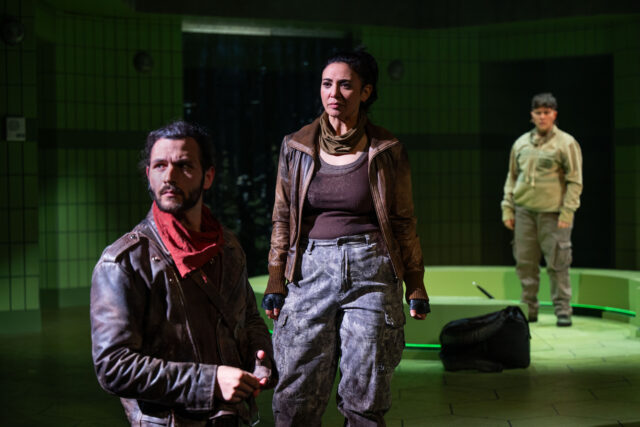
Jacob Leonard as Macduff, Melissa Oei as Ross, and Sara Vickruck as Malcolm in Macbeth (2026) | Photo by Emily Cooper
You play Macduff in Macbeth, who goes through something really devastating towards the end of the play. How do you approach a role like that?
Macduff is a hard one for me. I don’t have kids. I don’t have a wife. I know grief, but I was interested in the way Macduff handles grief, not the way Jacob handles grief. For me, Macduff is a man. He’s a dude. And how does a warrior dude man—quote that—process an immense thing? I started looking up videos of people getting told horrible news, while also looking at the text and seeing how he processes everything. I would often find that men don’t let it all out right away. There’s this weird silence that happens when they’re told, and that was inspiring to me. I was like, “Okay, how little can I do?” And then when you let it all come out, it’s this cocktail of anger and grief. So it was difficult, but more in the sense of like, “Okay, how am I going to do this?” I often find people think about these places that actors go as difficult, but I find it more difficult to deal with your own ego and expectations to just do the thing. What I don’t find difficult is trying to go to those places, because that’s what you want as an actor.
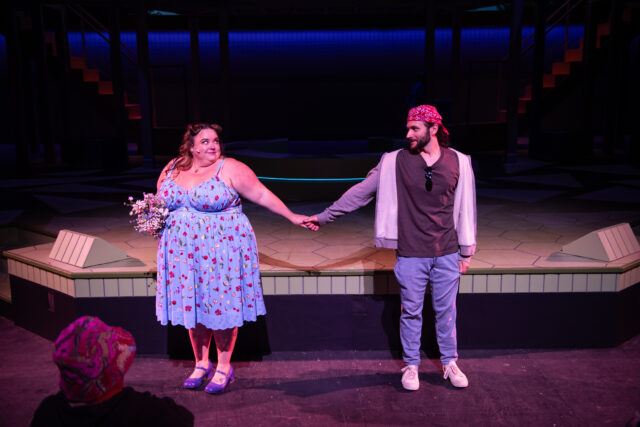
Steffanie Davis as Ms. Quickly and Jacob Leonard as Pistol in The Merry Wives of Windsor (2026) | Photo by Emily Cooper
On a lighter note, you—spoiler alert—have a memorable duet with Steffanie Davis in The Merry Wives of Windsor. How did that come about?
In the script, it says “Pistol (question mark?) sings with Ms. Quickly,” because even though my character is not that important to the overall story, we still wanted to give him a bit of a character arc of falling in love. Steff and I started talking, and she has such a great ear for songs that would just work for a certain moment. She suggested these two songs, one that’s the “I like you” song, and then the “now they’re going to—” So it’s mostly Steff. I just go “Yes” and “Can I sing that? Maybe.”
Do you have a favourite memory or a moment that stands out to you from your time at Bard?
Oh, there’s so many. We pulled a big prank on Craig Erickson last year. There was this video of him using a massage gun, and he just made this face. I took a still image of it from the video and printed out hundreds of it in different sizes, and over time—this was mostly me and Jen Tong—we would just leave them around the tent. We started out with one, and then a couple days would go by and we’d put ten more in random places, and eventually people started to go, “Where are all these pictures of Craig coming from?” And we’d be like, “What? Where?” This went on for a month, and we just kept going. At one point, I got paranoid that Craig knew it was me, and that he was playing me by letting me think he didn’t know. Then I thought, if he knows, we need a big finish, so we plastered his whole mirror and station with Craigs. It was like Christmas wrapping. We made an edited reveal video, and I vividly remember Craig, glasses on, going, “It’s Jacob?!”
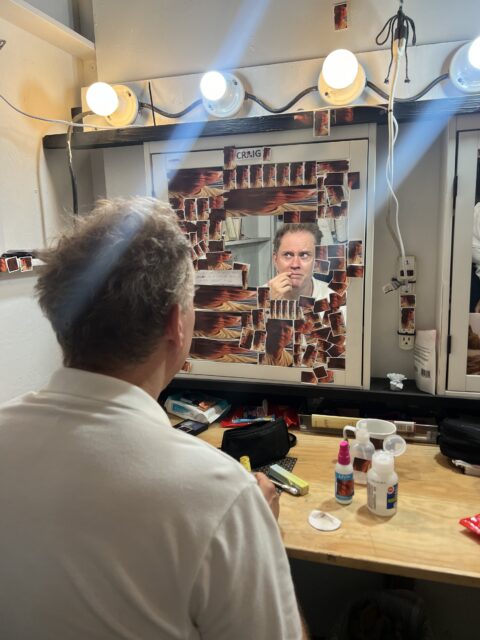
Photo by Jacob Leonard
Have you been reading, watching, or listening to anything good lately?
Stephen Drover and I have been talking about Pluribus, the new Vince Gilligan show. It’s awesome and it’s just so creative. I’ve been replaying Batman: Arkham Knight. Mark Hamill is awesome in that game. The whole kind of conceit is that Batman’s going through a Macbeth-like experience: Joker’s died in the game previously, and Joker’s coming back as this internal thing. He’s basically Banquo.
And finally, when you’re not here, how do you like to spend your time?
I like to read. I like to play video games and hang out with friends. I play piano and sing my own music a bit. I’ve also been getting into trying new restaurants.
Do you have a new favourite discovery?
Oh, yes. Big Way. Olympic Village.
Thanks so much for chatting with us, Jacob!
Make sure to see him this summer on our BMO Mainstage as Pistol and Rugby in The Merry Wives of Windsor and as Macduff in Macbeth. Tickets start at $30!
July 23, 11:46 am
Jacob was an amazing Proteus last year. The research he puts into his roles definitely pays off. I am very much looking forward to seeing his performance in The Merry Wives in September!
July 23, 11:26 am
I love him – his singing, his comedic timing, and now his serious take on Mc Duff. I hope he continues at Bard for a long time.